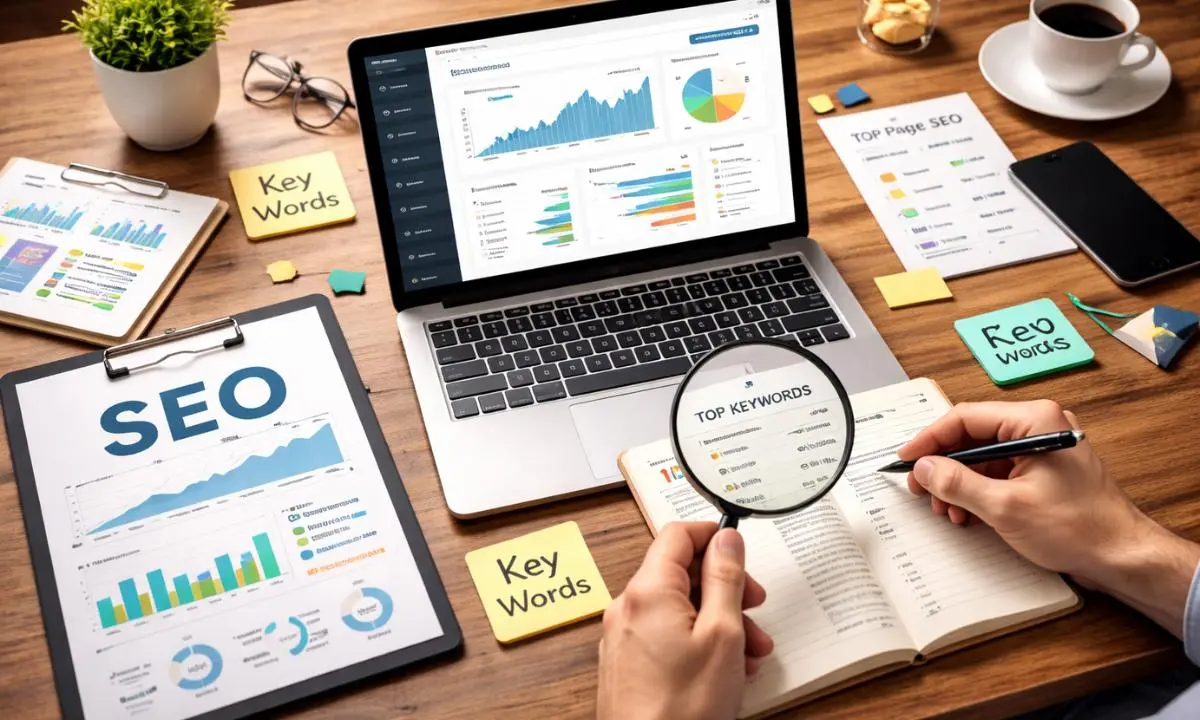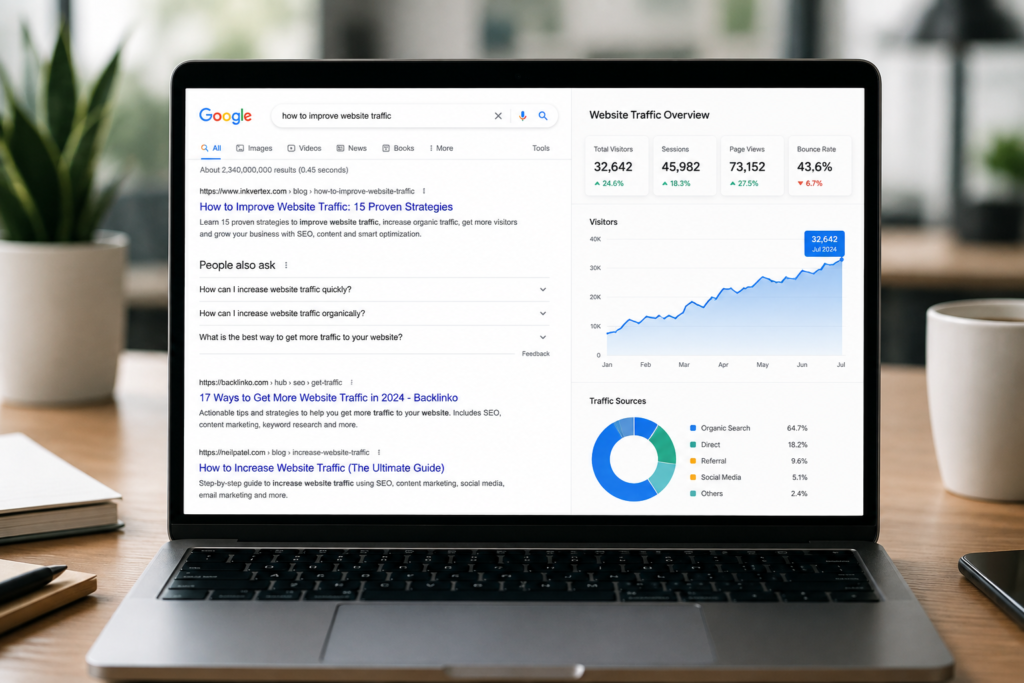
If you’re wondering how to improve website traffic, you’re not alone. Whether you run a business website, blog, or eCommerce store, increasing organic traffic is one of the biggest SEO challenges. This guide shares 15 proven SEO strategies to help you attract more visitors, improve Google rankings, and grow your website naturally.
You don’t need a huge marketing budget to increase website traffic. By combining SEO, high-quality content, technical optimization, and smart promotion, you can build a steady stream of organic visitors that continues growing over time.
With the right SEO strategy, useful content, technical improvements, and consistent optimization, you can improve website traffic organically and attract people who are actively looking for what your business offers.
In this guide, we’ll explain how to improve website traffic using 15 practical SEO strategies that businesses in India, the USA, Canada, and overseas markets can start implementing today.
Why Is Your Website Not Getting Organic Traffic?
Before learning how to improve website traffic, it’s important to understand why your website isn’t attracting enough organic visitors. Identifying the real cause helps you fix SEO issues faster and improve long-term Google rankings.
Launching a website does not automatically make it visible on Google. Search engines need to discover, crawl, understand, and evaluate your pages before they can potentially appear in relevant search results. Google also recommends creating useful, people-first content rather than producing pages primarily for search rankings.
Your website may struggle to attract visitors because:
- You are targeting the wrong keywords.
- Your content does not match search intent.
- Your website has not been properly indexed.
- Your pages provide little original value.
- Your competitors have stronger content and authority.
- Your website is slow or difficult to use.
- Your internal linking is weak.
- Your content is not being updated.
- Your website does not clearly communicate what your business offers.
- You are publishing content without a consistent SEO strategy.
The solution is not simply to publish more articles.
The goal is to create the right content for the right audience and the right search queries.
How to Increase Organic Website Traffic
Increasing organic website traffic is not about publishing more content every day. It’s about creating helpful, SEO-optimized pages that match what your audience is searching for.
The 15 strategies below combine on-page SEO, technical improvements, content marketing, and user experience to help drive sustainable traffic from Google.
How to Improve Website Traffic: 15 Proven Strategies
1. Start With Keyword Research
If you want to improve website traffic, keyword research should always be your first step. It helps you discover exactly what your target audience is searching for, so you can create content that matches user intent and ranks higher on Google.
Keyword research helps you identify the words and phrases people use when looking for information, products, or services related to your business.
Find Long-Tail Keywords With Search Intent
For example, a web design company might discover keywords such as:
- website design services
- small business website design
- how much does a business website cost
- how to improve website traffic
- how to get more customers from Google
Focus on search intent instead of search volume. A long-tail keyword with lower search volume often brings more qualified visitors because it matches exactly what users are looking for.
A keyword with 10,000 searches may be extremely competitive, while a keyword with 100–500 searches could bring highly relevant visitors who are much more likely to become customers.
Free keyword research tools
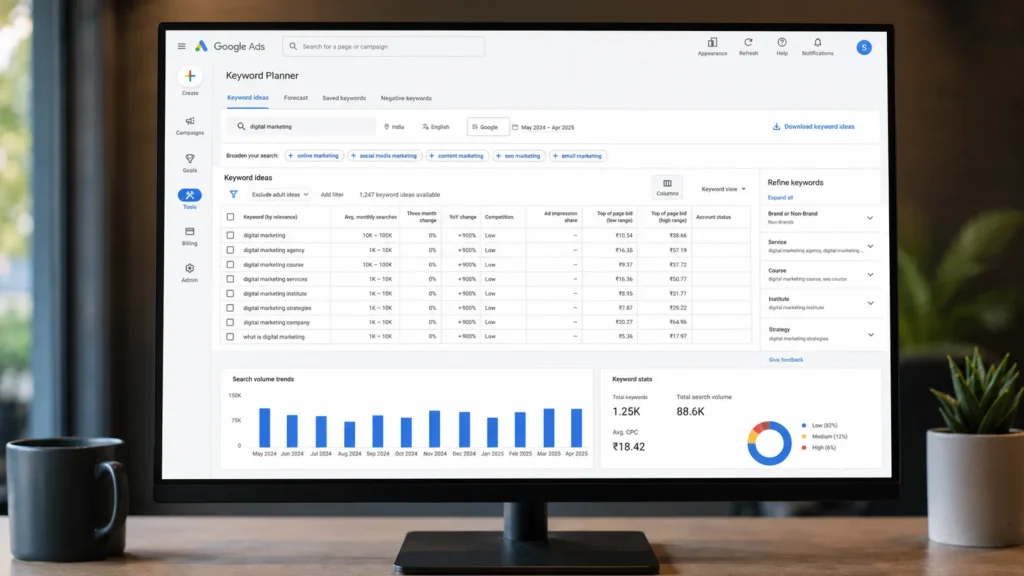
These free keyword research tools help you discover long-tail keywords, analyze search intent, and find content ideas that can improve website traffic without spending money on expensive SEO software.
You can start with:
- Google Keyword Planner
- Google Search
- Google Trends
- Google Search Console
- Google autocomplete
- People Also Ask
Use these tools regularly to identify new long-tail keywords, monitor search trends, and create content that consistently improves organic website traffic over time.
2. Match Search Intent
Search intent is the reason behind every Google search. If your content matches what users actually want, it has a much better chance of improving website traffic and ranking higher in search results.
Understanding search intent helps you create content that answers the exact question a user has. Google generally groups searches into informational, navigational, commercial, and transactional intent.
Types of Search Intent
For example, someone searching for:
Query: How to improve website traffic Intent: Informational — The user wants to learn SEO strategies, tips, and practical ways to increase organic traffic.
Someone searching for:
Query: SEO company for small business Intent: Commercial — The user is comparing service providers and is much closer to hiring an SEO company.
Always create content based on user intent, not just keywords. When your page answers the exact question users are searching for, Google is more likely to rank it for relevant search queries and increase organic website traffic.
Someone searching for:
“InkVertex” already knows the brand.
These are different search intents and should lead to different types of pages.
Before writing an article, search your target keyword on Google and examine the first-page results.
Ask:
- Are the results mostly blog posts?
- Are they service pages?
- Are they product pages?
- Are there videos?
- Are there guides?
- What questions appear in People Also Ask?
Your content should satisfy the intent behind the search.
3. Create Helpful, In-Depth Content
High-quality content is one of the strongest ranking factors for improving website traffic. Instead of writing for search engines, create original, helpful, and people-first content that completely answers your audience’s questions.
Avoid writing articles simply because a keyword has search volume.
Write People-First SEO Content
Before writing, ask yourself:
“What does my reader need to know after searching for this topic?”
A strong article should answer the main question while also addressing related questions and problems.
For example, an article about increasing website traffic could explain:
- SEO
- keyword research
- content strategy
- technical SEO
- internal linking
- backlinks
- website speed
- conversion optimization
- Google Search Console
- local SEO
The goal is not to publish longer content—it’s to publish better content. Comprehensive, well-structured articles that solve a user’s problem are more likely to improve website traffic and earn higher Google rankings.
Google explicitly recommends people-first content that provides substantial value and original information rather than content created primarily to manipulate rankings.
4. Optimize Your On-Page SEO
On-page SEO helps Google understand your content while making it easier for users to navigate your page. Proper titles, headings, URLs, and internal links all work together to improve website traffic and search visibility.
Important elements include:
SEO Title
Your SEO title should begin with the primary keyword, stay under 60 characters, and encourage users to click by clearly explaining the page’s value.
Example:
How to Improve Website Traffic (15 Proven SEO Strategies)
URL
Keep your URL short, readable, and focused on the primary keyword. Avoid unnecessary numbers, dates, or extra words.
Example:
/how-to-improve-website-traffic/
H1
Use only one H1 on each page, and make sure it contains your primary keyword naturally. A clear H1 helps both Google and users understand the main topic.
H2 and H3 headings
Organize your article with descriptive H2 and H3 headings. This improves readability, helps search engines understand your content structure, and increases the chances of ranking for related keywords.
Meta description
Write a compelling meta description between 150–160 characters that includes your primary keyword and clearly explains the benefit of reading the page. A strong meta description can improve click-through rate from Google.
Internal Linking
Internal links help search engines discover related pages while guiding visitors to useful content. Link naturally to relevant blogs and service pages using descriptive anchor text instead of generic phrases like “click here.”
- Link to related blog posts
- Connect relevant service pages
- Use descriptive anchor text
- Add 3–5 internal links naturally
Images
Optimize every image with a descriptive filename, meaningful alt text, and the WebP format. Fast, accessible images improve both user experience and organic search visibility.
- Use WebP images whenever possible
- Keep image size under 150 KB
- Add descriptive ALT text
- Include the primary keyword naturally in one image ALT
- Rename files before uploading (e.g.
how-improve-website-traffic.webp)
Internal links
Link to other relevant pages on your website.
Google recommends clear titles and logical page structures because they help both users and search engines understand your content.
5. Improve Your Website’s Loading Speed
Website speed directly affects user experience, bounce rate, and Google rankings. A fast-loading website keeps visitors engaged and improves your chances of increasing organic traffic.
Speed Optimization Checklist
- Compress images before uploading
- Enable browser caching
- Minify CSS and JavaScript
- Use lazy loading for images
- Choose reliable hosting
Large images, unnecessary scripts, excessive plugins, poor hosting, and unoptimized code can all contribute to slow loading times.
Start by checking your website with Google’s free PageSpeed Insights tool.
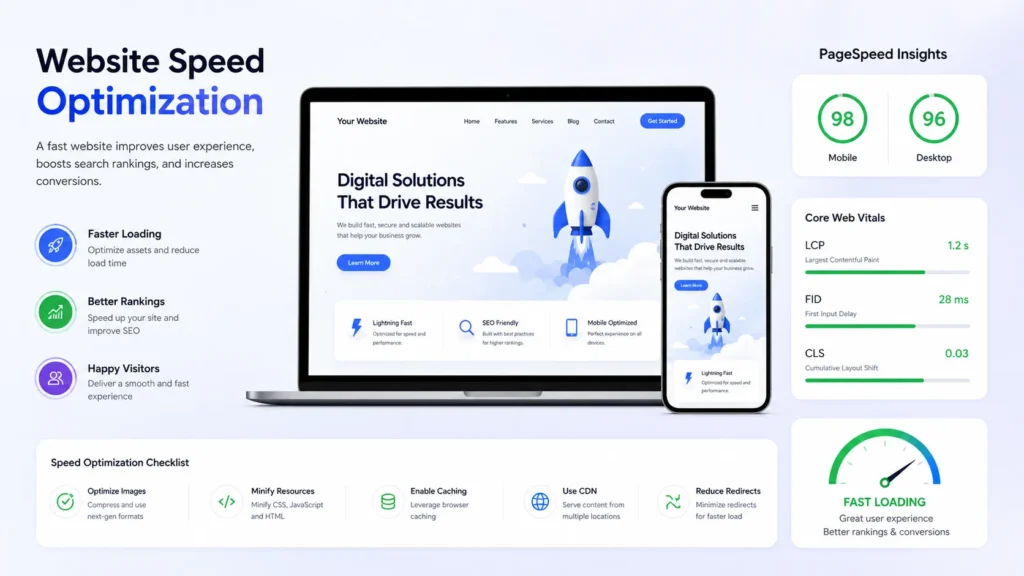
Look for opportunities to:
- Compress large images.
- Use modern image formats.
- Remove unnecessary scripts.
- Reduce unused CSS and JavaScript.
- Improve server response time.
- Use browser caching where appropriate.
- Avoid loading unnecessary third-party resources.
Website performance is not just about getting a perfect score.
Google recommends focusing on the overall page experience and user experience. Core Web Vitals measure loading performance, responsiveness, and visual stability.
6. Build a Strong Internal Linking Strategy
Internal links are links from one page on your website to another page on the same website.
For example, if this article discusses SEO content, you could link to a detailed article about SEO content writing.
Internal linking helps visitors discover related information and helps search engines understand the relationship between pages.
Instead of randomly adding links, create logical connections.
For example:
Pillar page:
How to Improve Website Traffic
↓
Supporting content:
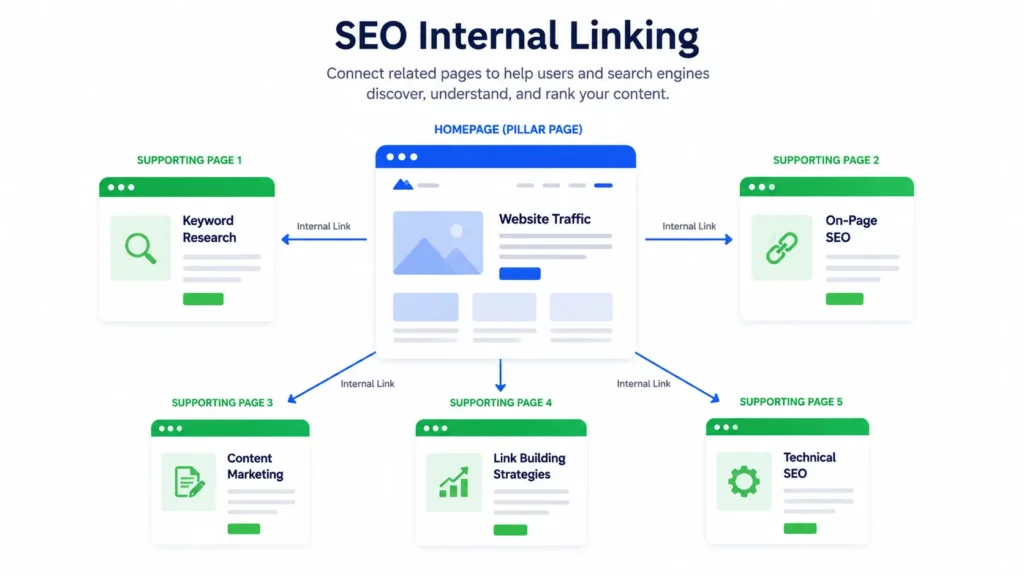
- How to Improve Website Ranking
- Why Is My Website Not Ranking on Google?
- SEO Content Writing Guide
- Local SEO for Small Businesses
- How to Write SEO-Friendly Blog Posts
Use descriptive anchor text rather than generic phrases such as “click here.”
Google recommends logical site structures and concise, relevant internal-link anchor text.
7. Optimize for Mobile Users
A large portion of web traffic comes from smartphones.
If your website looks great on a desktop but is difficult to use on a phone, you may lose potential customers.
Check whether:
- Text is easy to read.
- Buttons are large enough to tap.
- Navigation works properly.
- Images fit the screen.
- Forms are easy to complete.
- Important information appears without excessive scrolling.
Mobile optimization should be part of your overall website design rather than something added at the end.
8. Create Content Around Topics, Not Just Keywords
One article rarely builds strong topical authority by itself.
Instead of publishing unrelated articles every week, organize your content into connected topic clusters.
For example, if your main topic is website traffic, you could build a cluster around it.
Main topic
How to Improve Website Traffic
Supporting topics
- How to Increase Organic Traffic
- Why Is My Website Not Getting Traffic?
- Why Is My Website Not Ranking on Google?
- How to Improve Website Ranking
- SEO Content Writing for Small Businesses
- Local SEO Strategies
- How to Get Website Traffic Without Paid Ads
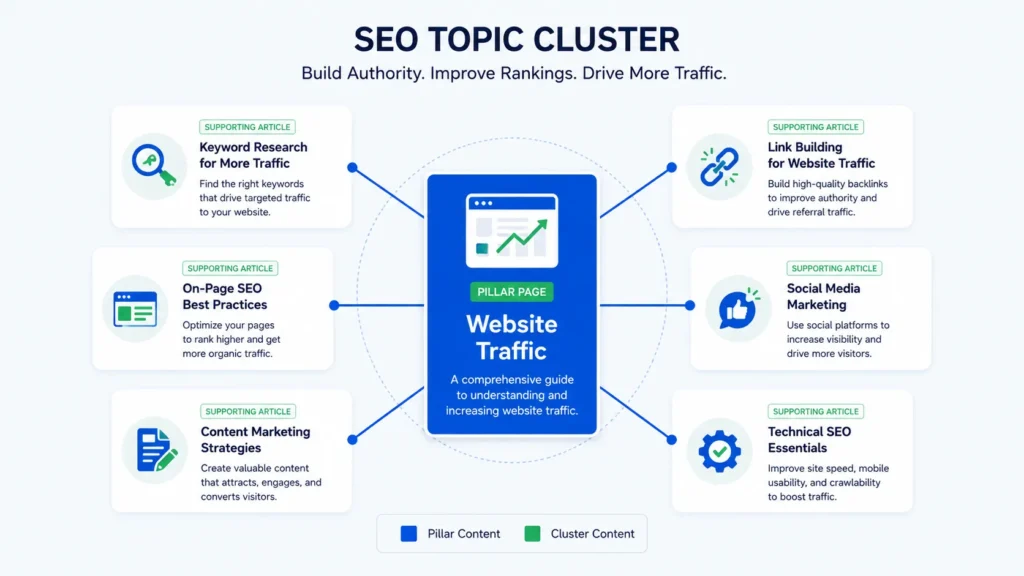
Then connect these articles with internal links.
This creates a useful resource ecosystem instead of a collection of unrelated blog posts.
9. Improve Your Website’s Search Visibility With Technical SEO
Technical SEO makes it easier for search engines to crawl, understand, and index your website.
You do not need to be a developer to understand the basics.
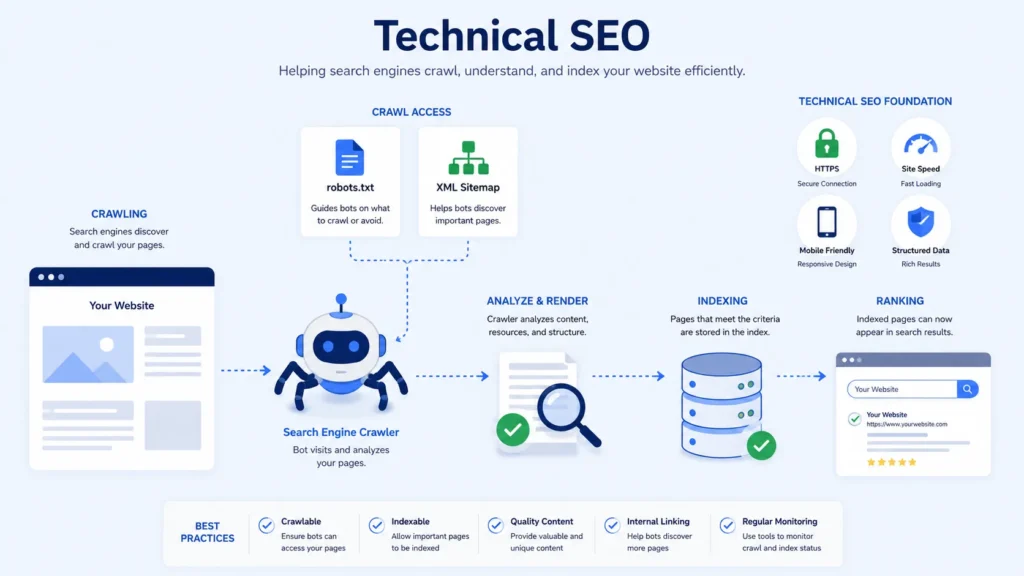
Check that your website has:
- HTTPS
- An XML sitemap
- A properly configured robots.txt file
- Search Console verification
- Clean URLs
- No unnecessary duplicate pages
- Proper redirects
- Mobile-friendly pages
- Indexable important content
If a valuable page cannot be crawled or indexed, great content alone will not solve the problem.
Google provides tools and documentation through Search Console to help website owners monitor how their pages perform in Google Search.
10. Use Google Search Console
If you want to grow organic website traffic, Google Search Console should be one of your most important free tools.
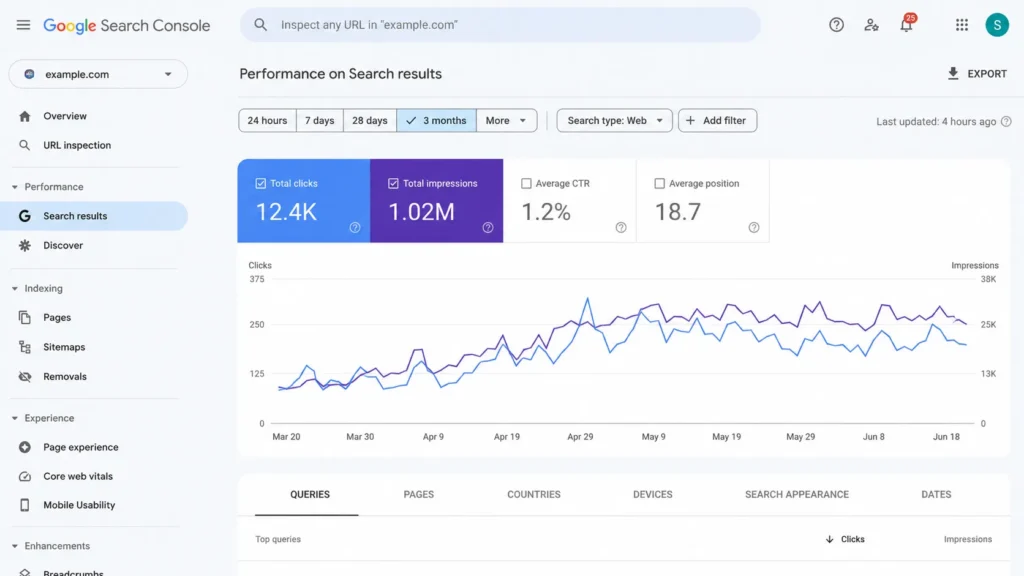
Search Console can help you understand:
- Which queries show your website.
- Which pages receive impressions.
- Which pages get clicks.
- Your average search position.
- Your click-through rate.
- Indexing issues.
- Search performance trends.
You can use this information to find opportunities.
For example, suppose a page receives thousands of impressions but very few clicks.
That may indicate an opportunity to improve the page’s title and snippet appeal.
Suppose another page ranks around positions 8–15 for several related queries.
That page may be a good candidate for a content update.
11. Refresh Your Existing Content
Creating new content isn’t always the best way to increase website traffic.
Sometimes your existing pages already have ranking potential.
Review older articles and ask:
- Is the information still accurate?
- Are statistics outdated?
- Are there better examples you can add?
- Are new questions missing?
- Can you improve the introduction?
- Are there broken links?
- Can you add useful internal links?
- Is the title still accurate?
Updating content should mean making a meaningful improvement—not simply changing the publication date.
Google’s guidance emphasizes keeping useful content accurate and up to date while avoiding superficial freshness tactics.
12. Earn Relevant Backlinks
Backlinks are links from other websites to your website.
Not every backlink is equally valuable.
A relevant link from a trustworthy website can be much more useful than dozens of low-quality links.
Instead of buying random backlinks, focus on earning them naturally.
Some approaches include:
- Publishing original research.
- Creating useful statistics or resources.
- Contributing expert insights.
- Digital PR.
- Industry partnerships.
- Guest contributions on relevant publications.
- Creating genuinely link-worthy guides.
The goal should be quality and relevance, not simply increasing the number of links.
13. Optimize for Local SEO
If your business serves a particular city, region, or local market, local SEO can be an excellent source of targeted traffic.
For example, a web design company serving businesses in Toronto could create useful content around:
- Website design for Toronto small businesses
- Local SEO for Toronto businesses
- How Toronto businesses can improve Google visibility
A U.S. business might target a specific service area in a similar way.
Create useful local landing pages where they genuinely help users, optimize your Google Business Profile, maintain consistent business information, and publish locally relevant content.
Avoid creating dozens of nearly identical city pages simply to target keywords.
14. Improve Your Click-Through Rate
Getting impressions is useful, but clicks are what bring visitors to your website.
If your page appears in search results but receives very few clicks, review your title and page description.
For example:
Weak:
Website Traffic | Company Name
Better:
How to Improve Website Traffic: 15 Proven Strategies
Your title should clearly tell the searcher what they will get from the page.
Google recommends descriptive, concise titles and warns against keyword stuffing. Google may also generate the displayed title from several sources on the page, so your visible heading, title element, and content should clearly describe the same topic.
15. Make Your Website Convert Traffic Into Leads
More traffic isn’t always better.
Imagine your website receives 10,000 visitors but generates only two leads.
Another website receives 1,000 highly relevant visitors and generates 50 leads.
The second website has a much better business outcome.
That’s why traffic and conversion strategy should work together.
Make it easy for visitors to take the next step.
Depending on your business, this could be:
- Request a quote
- Book a consultation
- Contact your team
- Request an SEO audit
- Download a guide
- Schedule a call
- Start a project
Your call-to-action should be relevant to the page.
For example, someone reading an article about website traffic may be interested in an SEO audit or content strategy consultation.
Free Tools to Improve Website Traffic
You don’t need an expensive SEO software subscription to start improving your website.
Here are some useful free tools.
| Tool | What You Can Use It For |
|---|---|
| Google Search | Search intent and competitor research |
| Google Keyword Planner | Keyword ideas and search-volume ranges |
| Google Trends | Search interest and trends |
| Google Search Console | Organic performance and indexing |
| Google Analytics | Website traffic and user behavior |
| PageSpeed Insights | Website performance |
| Google Rich Results Test | Structured-data testing |
| Bing Webmaster Tools | Bing search performance |
| Google Sheets | Keyword and content planning |
Start with these before paying for expensive SEO platforms.
Common Mistakes That Can Stop Website Traffic
Even businesses that invest in SEO can make mistakes that slow their growth.
Publishing Without Keyword Research
Writing whatever comes to mind may produce content, but it doesn’t necessarily create search demand.
Keyword Stuffing
Repeating the same keyword dozens of times can make your content unnatural and difficult to read.
Write naturally and cover the topic comprehensively.
Copying Competitors
Looking at competitors for research is fine.
Copying their content is not.
Your page should provide original value.
Chasing Every Trending Topic
Not every trending keyword is relevant to your customers.
Build content around your actual audience and business expertise.
Ignoring Technical SEO
Great content cannot perform properly if important pages cannot be crawled or indexed.
Publishing Too Many Low-Quality Articles
More content does not automatically mean more traffic.
Focus on useful content that serves a clear purpose.
Google specifically advises against creating large amounts of content primarily to attract search-engine traffic.
Website Traffic Growth Checklist
Before publishing a new page, run through this checklist:
Keyword Research
- Primary keyword selected
- Search intent understood
- Related keywords identified
- Target audience defined
Content
- Topic provides genuine value
- Introduction answers the user’s problem
- Headings are easy to scan
- Examples are included
- Content is original
- Information is accurate and current
On-Page SEO
- SEO title written
- Meta description written
- Clean URL created
- One clear H1
- Relevant H2/H3 headings
- Internal links added
- External sources added where useful
- Images optimized
- Alt text added where appropriate
Technical SEO
- Page is indexable
- Website uses HTTPS
- Mobile experience is good
- Page loads efficiently
- No major broken links
- Sitemap is available
Conversion
- Relevant CTA included
- Contact option is easy to find
- Service page linked where appropriate
Frequently Asked Questions
How can I increase website traffic quickly?
There is no reliable shortcut that guarantees fast organic traffic. Start by targeting relevant search queries, improving existing pages, publishing useful content, fixing technical issues, and promoting your best resources. SEO generally requires consistent effort rather than a one-time change.
How can I increase website traffic organically?
Focus on SEO, helpful content, keyword research, internal linking, technical SEO, local SEO where relevant, and earning quality mentions or backlinks. Google recommends creating content primarily to help people rather than creating pages mainly to manipulate search rankings.
How long does it take to increase website traffic?
The timeline varies significantly depending on your website’s authority, competition, content quality, technical condition, industry, and consistency. New websites often need time to establish visibility and authority.
Can I increase website traffic without paid advertising?
Yes. Organic search, referrals, direct traffic, social media, email marketing, partnerships, and other unpaid channels can generate visitors. SEO is particularly useful for building long-term organic visibility.
Why is my website getting impressions but no clicks?
Low clicks despite impressions can indicate that your search result is not compelling enough, the query doesn’t match the page well, or you’re competing against stronger results. Review your title, content relevance, search intent, and page positioning in Search Console.
Should I focus on traffic or leads?
For most businesses, relevant traffic is more valuable than traffic volume alone. The ultimate objective should be attracting visitors who are likely to become customers.
Is SEO still important for small businesses?
Yes. Search can help small businesses reach people who are actively looking for their products, services, or information. The strategy should focus on relevant topics, realistic keywords, strong local visibility where appropriate, and genuinely useful content.
What is the best free tool for tracking website traffic?
Google Analytics can help you understand website usage and traffic sources, while Google Search Console is particularly useful for understanding how your website performs in Google Search.
Final Thoughts: How to Improve Website Traffic the Right Way
Learning how to improve website traffic is not about finding one secret SEO trick.
Sustainable growth comes from getting several fundamentals right at the same time.
- Start with keyword research.
- Understand search intent.
- Create genuinely useful content.
- Optimize your pages.
- Build logical internal links.
- Improve technical SEO.
- Monitor Search Console.
- Update existing content.
- Earn relevant authority.
And most importantly, make sure your website gives visitors a clear reason to take the next step.
Whether your business is in India or overseas, treat SEO as an ongoing growth strategy, not a one-time task.
Treat it as an ongoing growth system.
At InkVertex, we help businesses strengthen their online presence through SEO-focused content, website design, and digital growth strategies. If your website is getting little traffic—or you’re getting traffic but not enough qualified leads—our team can help identify the opportunities holding your website back.
Ready to turn your website into a stronger growth channel? Contact InkVertex to discuss your SEO and website goals.